
Key Takeaways
- SD-WAN focuses on connecting locations and routing traffic intelligently across available network links, such as broadband, MPLS, and cellular connections.
- SASE combines networking with cloud-delivered security capabilities. A SASE architecture commonly brings together SD-WAN and security services such as Secure Web Gateway (SWG), Firewall as a Service (FWaaS), and Zero Trust Network Access (ZTNA).
- SD-WAN and SASE are not direct substitutes in every scenario. SD-WAN can be deployed on its own, while SASE extends the architecture to help secure access for users, devices, applications, and locations.
- Organizations with distributed offices, remote employees, SaaS applications, and cloud workloads may benefit from a SASE approach, depending on their security and connectivity requirements.
- A business can use SD-WAN alongside cloud security services or adopt an integrated SASE solution. The right model depends on existing infrastructure, risk, operational capacity, and future plans.
- Before choosing a solution, assess network performance, security controls, identity requirements, application access, licensing, support, and total cost of ownership.
Why SASE and SD-WAN Matter for Enterprise Networks in 2026
Enterprise networks now need to support more than traffic between offices and a central data center. Employees work from corporate locations, homes, customer sites, and while travelling. Business applications may run in private data centers, public cloud environments, and Software-as-a-Service (SaaS) platforms.
Traditional network designs can route traffic through a central location for inspection before it reaches the internet or cloud applications. Depending on the architecture, this may add latency, increase backhaul traffic, and make it harder to apply consistent policies to users outside the office.
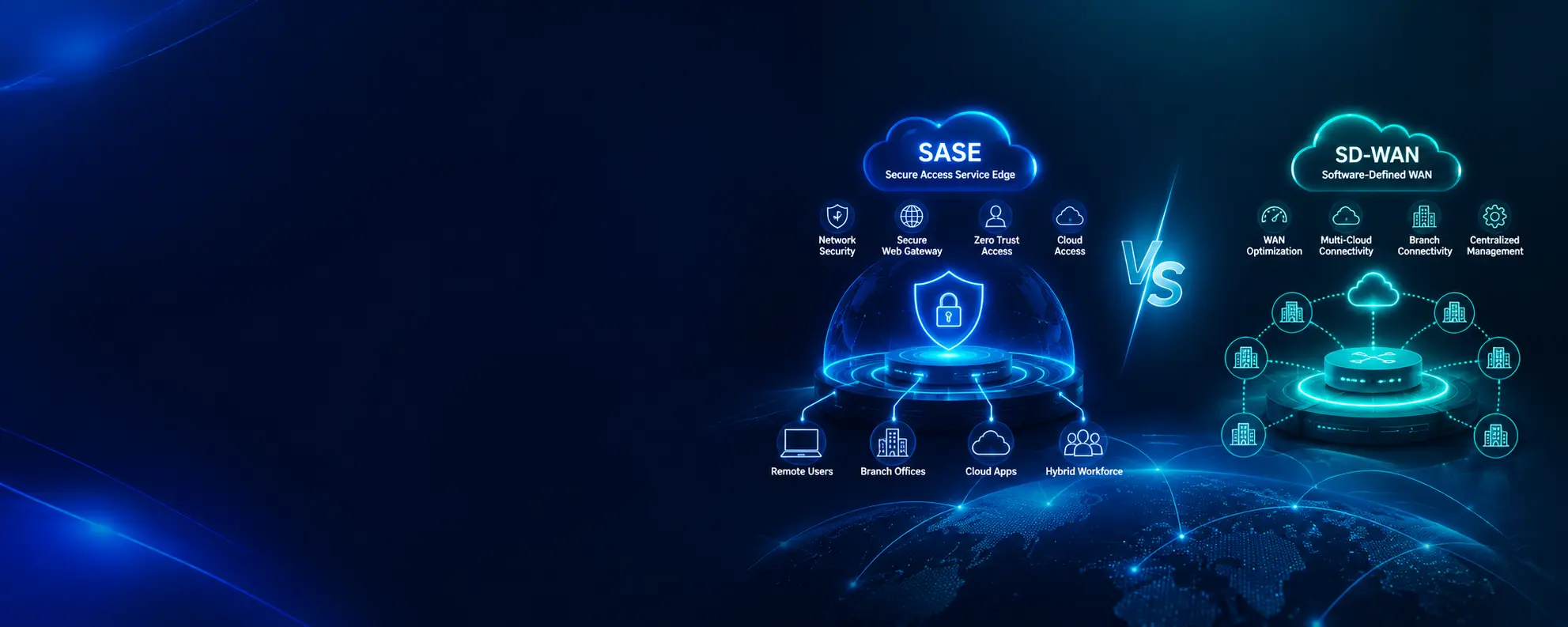
Software-Defined Wide Area Networking (SD-WAN) helps organizations manage connectivity across distributed locations. Secure Access Service Edge (SASE) brings networking and security capabilities together in an architecture designed to support users and applications across locations.
Although the terms are often discussed together, they solve different parts of the enterprise networking challenge. Understanding the difference helps IT teams plan a network that balances performance, security, manageability, and cost.
This guide explains how SASE and SD-WAN work, compares their capabilities, and outlines how businesses can evaluate the right approach.
What Is SD-WAN?
SD-WAN stands for Software-Defined Wide Area Network. It uses software-based policies and centralized management to control how traffic moves across wide area network connections between offices, data centers, cloud environments, and other destinations.
An SD-WAN solution can use multiple types of connectivity, including business broadband, dedicated internet access, MPLS, and supported cellular links. Based on the platform and configured policies, it can select paths according to application requirements, link health, availability, and business priorities.
How SD-WAN Works
A typical SD-WAN deployment includes:
- Branch or edge devices: Physical appliances or virtual components that connect locations to the SD-WAN fabric.
- WAN links: Available network connections, such as broadband, MPLS, or cellular connectivity.
- Centralized orchestration and management: Tools used to configure policies, deploy changes, monitor network conditions, and manage devices.
- Application-aware traffic steering: Rules that direct traffic across suitable links based on configured requirements and available performance data.
- Network visibility: Monitoring and reporting that help IT teams understand link health, application experience, and connectivity issues.
For example, a company with offices in several cities might use SD-WAN to route latency-sensitive business applications over a preferred link while allowing less critical traffic to use another available connection. If a link degrades, the solution may steer eligible traffic to another path, depending on policy and platform capabilities.
Key Benefits of SD-WAN
1. Centralized network management
IT teams can apply consistent connectivity policies across distributed branches instead of configuring every site independently. The level of automation depends on the chosen platform and implementation.
2. Flexible use of network links
SD-WAN can help organizations use different types of WAN connectivity according to availability, performance, cost, and application needs.
3. Application-aware routing
Traffic can be prioritized or steered based on application and network conditions. This can improve application experience when policies and underlying links are properly designed.
4. Improved visibility
Centralized monitoring can help teams identify degraded links, routing issues, and application connectivity problems more efficiently.
5. Support for distributed locations
SD-WAN can simplify the management of networks connecting branch offices, retail sites, campuses, and other distributed business locations.
SD-WAN is primarily a connectivity and traffic-management approach. It may include security features, but the exact protection available varies by vendor and product. Organizations should not assume that an SD-WAN deployment automatically provides every security capability included in a comprehensive SASE architecture.
What Is SASE?
SASE stands for Secure Access Service Edge. It is an enterprise architecture that combines networking capabilities with security services, often delivered through a cloud-based service, to connect users, devices, and locations to applications under consistent access policies.
SASE is intended to help organizations apply security closer to where users connect and where applications are accessed, rather than relying only on security controls located at a central corporate perimeter.
A SASE architecture commonly includes SD-WAN or other network connectivity capabilities alongside cloud-delivered security services. The exact components and degree of integration differ between vendors and offerings.
Common SASE Components
- SD-WAN: Connects locations and steers traffic across WAN links based on policies and network conditions.
- Secure Web Gateway (SWG): Applies security policies to web traffic and can help block access to malicious or prohibited destinations.
- Firewall as a Service (FWaaS): Delivers firewall capabilities through a service model, subject to the provider's features and policies.
- Zero Trust Network Access (ZTNA): Provides controlled access to specific applications based on identity, device context, and defined access policies.
- Cloud Access Security Broker (CASB): Helps enforce security policies around supported cloud applications and services.
- Data Loss Prevention (DLP): Helps identify and control sensitive data movement, depending on product capabilities and configuration.
- Centralized policy and visibility: Helps administrators manage access and security rules across supported users, devices, locations, and applications.
Not every SASE offering includes every capability in the same way. Some providers bundle multiple services into one platform, while others integrate products from different vendors. Buyers should validate the specific features, integrations, coverage, and licensing included in a proposed solution.
How SASE Works
In a SASE model, a user or office connects through an appropriate access method. The solution evaluates applicable identity, device, network, and security policies before allowing access to a destination. Traffic may be inspected or controlled by the relevant security services, based on the architecture and configured policies.
For example, a remote employee accessing a company application may be granted access only to that application after the required identity and device checks. The employee does not necessarily need broad access to the entire corporate network.
SASE can help organizations apply more consistent security policies to office-based and remote users, but implementation quality matters. Identity integration, endpoint posture, policy design, logging, exception handling, and incident response remain essential.
SASE vs SD-WAN: Key Differences
| Factor | SD-WAN | SASE | | --- | --- | --- | | Primary purpose | Optimize and manage WAN connectivity | Combine network access with security services | | Main focus | Traffic routing, link selection, application performance, and connectivity | Secure access for users, devices, locations, and applications | | Network connectivity | Core capability | May include SD-WAN or integrate with networking services | | Security services | Varies by vendor; may include selected security features | Commonly combines multiple security services in an integrated architecture | | Remote users | May require additional remote-access and security solutions | Designed to support secure access for distributed users, depending on the service | | Cloud and SaaS access | Can optimize paths to cloud and internet destinations | Can combine access optimization with cloud-delivered security controls | | Zero Trust access | Not inherent to every SD-WAN deployment | Often integrates ZTNA or related identity-aware access controls | | Management | Centralized WAN and traffic policy management | Networking and security policy management, depending on integration | | Deployment | Edge appliances, virtual components, or managed services | Often cloud-delivered, with possible branch, endpoint, and on-premises components | | Typical use cases | Branch connectivity, WAN modernization, application-aware routing | Distributed access security, cloud-first networks, remote workforce protection | | Cost considerations | WAN devices, licenses, circuits, support, and operations | Security and networking subscriptions, integration, connectivity, support, and operations | | Relationship | Can operate as a standalone WAN solution | Can incorporate SD-WAN or work with existing network infrastructure |
The central distinction is that SD-WAN manages how network traffic travels, while SASE brings network connectivity and security services into a broader access architecture. They can complement each other rather than compete as mutually exclusive choices.
SASE vs SD-WAN: Which One Provides Better Security?
Security is one of the most important differences between the two approaches, but the answer depends on the specific products and architecture being compared.
SD-WAN Security
Many SD-WAN products provide some combination of encrypted tunnels, segmentation, access controls, or integrated firewall functions. These capabilities can help protect network connections and separate traffic between sites.
However, the security feature set differs significantly by platform. An SD-WAN product may require integration with separate firewalls, secure web gateways, endpoint controls, identity providers, or remote-access solutions to meet an organization's requirements.
SASE Security
SASE is designed to combine networking with multiple security services. Depending on the offering, it can help apply consistent policies to web access, private application access, cloud usage, and traffic from distributed locations.
A SASE design can reduce the need to send all traffic through a central office solely for security inspection, but traffic paths and inspection points depend on the provider's architecture and configuration.
Important Security Considerations
When evaluating either approach, businesses should review:
- Identity and authentication: Integration with identity providers and multifactor authentication.
- Least-privilege access: Limiting users and devices to the applications and resources they need.
- Threat protection: Capabilities for detecting or blocking malicious content, threats, and suspicious activity.
- Network segmentation: Separation of users, devices, applications, and sensitive environments where appropriate.
- Data protection: Controls for sensitive data and cloud application usage.
- Logging and monitoring: Visibility into access decisions, security events, and policy violations.
- Incident response: Processes for investigation, containment, escalation, and recovery.
- Compliance requirements: Evidence, retention, data residency, and control requirements relevant to the business.
Neither the SASE label nor the presence of SD-WAN guarantees a secure deployment. Validate specific controls, test integrations, and ensure the solution fits the organization's risk and compliance requirements.
Performance, Cloud Access, and Remote Work
Network Performance
SD-WAN can improve WAN traffic management by selecting paths according to application policies and network conditions. Actual performance depends on available circuits, routing design, endpoint conditions, application hosting, and the platform's capabilities.
SASE adds security processing and access-policy enforcement to the broader architecture. A well-designed service can provide convenient access to cloud and private applications, but the location of inspection points, provider coverage, routing, and service capacity can affect latency and user experience.
Businesses should test important applications from their actual offices and user locations before selecting a solution.
Cloud and SaaS Applications
Organizations using SaaS applications need reliable connectivity as well as appropriate controls over access and data. SD-WAN can help manage paths to cloud and internet destinations. SASE can combine network access with services that inspect or control supported web and cloud traffic.
For example, SD-WAN may help a branch office select a suitable internet path for a business application, while SASE security policies may control which users can access the application and what protections apply to that traffic.
Remote and Hybrid Employees
SD-WAN is generally associated with connecting networks and locations, although individual products may support additional remote-access options. SASE is designed to address access security across distributed users and locations, often through cloud-delivered services and identity-aware policies.
Organizations with many remote employees should assess endpoint coverage, identity integration, application access, device posture checks, and the user experience across different locations.
Cost Comparison: What Should Businesses Evaluate?
Comparing SASE and SD-WAN costs requires more than comparing two subscription prices. Their scopes may differ, and a fair comparison should include the existing infrastructure and all services needed to meet the organization's requirements.
Costs to Evaluate for SD-WAN
- Branch appliances, virtual components, and any required hardware refresh.
- SD-WAN licenses, subscriptions, and centralized management.
- Internet circuits, MPLS services, cellular links, and other connectivity costs.
- Firewalls or separate security services not included in the chosen product.
- Deployment, integration, monitoring, support, and staff training.
- Redundant connectivity and business continuity requirements.
Costs to Evaluate for SASE
- Per-user, per-device, bandwidth-based, or site-based subscriptions, according to the provider's pricing model.
- Included and optional security services, feature tiers, and licensing limits.
- SD-WAN equipment or services, if required.
- Internet connectivity and any branch infrastructure that remains necessary.
- Identity integration, endpoint requirements, migration, and policy configuration.
- Logging, retention, support, training, and ongoing administration.
- Costs associated with overlapping tools during transition.
SASE may help consolidate overlapping networking and security services, but consolidation savings are not automatic. Existing contracts, usage levels, licensing structure, service coverage, and implementation effort all affect the business case.
Practical recommendation: Compare the total cost of ownership (TCO) over the same planning period. Include connectivity, hardware, subscriptions, implementation, security coverage, support, and the operational cost of managing the environment.
When Should Businesses Choose SD-WAN?
SD-WAN is worth evaluating when an organization:
- Needs to connect multiple branch offices, retail outlets, campuses, or other distributed locations.
- Wants centralized WAN configuration and monitoring.
- Uses multiple WAN connections and needs policy-based traffic steering.
- Wants to improve application performance or resilience across available links.
- Is modernizing an MPLS-based network or reviewing the mix of connectivity services.
- Already has security platforms that meet its requirements and needs a more flexible WAN layer.
SD-WAN may be a good fit when the primary challenge is network connectivity and traffic management. The organization should still map its security requirements and determine whether existing protections are sufficient or additional services are needed.
When Should Businesses Choose SASE?
SASE is worth evaluating when an organization:
- Has a distributed workforce accessing applications from offices, homes, and other locations.
- Uses cloud services and SaaS applications extensively.
- Wants to apply more consistent security policies to users and locations.
- Needs identity-aware access to private applications rather than broad network access.
- Is reviewing separate tools for web security, firewall services, remote access, and cloud access controls.
- Wants to simplify operations through a more integrated networking and security architecture.
SASE may be particularly relevant when the organization is modernizing both its WAN and its access-security model. It is not automatically the best option for every business: requirements, existing investments, provider coverage, data handling, integration, and operational readiness should guide the decision.
Can Businesses Use SASE and SD-WAN Together?
Yes. SD-WAN can be a component of a SASE architecture, and organizations can also combine an SD-WAN deployment with separate cloud-delivered security services. The best arrangement depends on the products involved and how tightly their policies and management systems integrate.
For example, a company might use SD-WAN to connect its branch offices and steer traffic across multiple internet circuits, while a SASE service provides secure web access and identity-aware access to private applications. Another organization may choose an integrated platform that combines both functions under a common policy model.
Before combining solutions, check for duplicated features, inconsistent policies, overlapping subscriptions, management complexity, and gaps in logging or incident response.
A Practical Decision Framework
- Document the current environment: List offices, users, applications, WAN links, cloud services, security tools, and network dependencies.
- Identify the main problem: Determine whether the priority is WAN performance, connectivity resilience, remote access, cloud security, policy consistency, or several of these.
- Define security requirements: Specify identity controls, application access, threat protection, data protection, logging, and compliance needs.
- Assess existing investments: Identify which network and security tools can be retained, integrated, replaced, or retired.
- Compare architectures: Evaluate standalone SD-WAN, SD-WAN with separate security services, and integrated SASE options against the same requirements.
- Validate interoperability: Check support for identity providers, endpoint platforms, cloud applications, branch devices, and existing firewalls.
- Run a pilot: Test performance, failover, policy enforcement, remote access, logging, and support workflows with representative users and sites.
- Calculate TCO: Include licensing, circuits, hardware, deployment, support, and ongoing operations.
- Plan migration and recovery: Define rollout phases, fallback procedures, change windows, and ownership for ongoing management.
This approach helps teams choose an architecture based on business needs and measurable outcomes instead of product terminology alone.
Enterprise Network Evaluation Checklist
Before approving an SD-WAN or SASE project, confirm that the proposal addresses:
- Connectivity: WAN types, bandwidth, redundancy, failover, and branch requirements.
- Application experience: Latency, packet loss, critical application priorities, and cloud access paths.
- Identity and access: User authentication, device posture, least privilege, and private application access.
- Security services: Firewalling, web security, threat prevention, data controls, and segmentation as required.
- Visibility: Network telemetry, security logs, reporting, and integration with monitoring or security operations tools.
- Compatibility: Existing network devices, endpoint platforms, identity providers, and cloud applications.
- Availability: Provider coverage, service-level commitments, redundant links, and recovery procedures.
- Compliance: Applicable data protection, retention, audit, and regulatory requirements.
- Commercial terms: Subscription scope, renewal terms, support, implementation charges, and licensing limits.
- Operations: Administrator skills, escalation paths, policy ownership, and ongoing maintenance.
- Lifecycle planning: Expansion to new sites, user growth, contract renewals, and future architecture changes.
A complete evaluation makes it easier to compare proposals fairly and reduces the risk of buying overlapping tools or leaving important requirements unaddressed.
How Movantech Supports Enterprise Networking and Cybersecurity Requirements
Movantech Systems supports enterprise IT procurement and technology sourcing across networking, cybersecurity, IT infrastructure, data center equipment, and related technology requirements.
For an SD-WAN or SASE project, organizations may need to evaluate network appliances, security solutions, connectivity requirements, subscriptions, support coverage, compatibility, and deployment scope. These details should be matched to the technical design and commercial requirements before a purchase decision is made.
Movantech can support organizations with:
- Enterprise networking and cybersecurity product sourcing.
- Network infrastructure and security hardware procurement.
- Vendor and product specification coordination.
- Bulk and project-based IT sourcing.
- Quotation comparison and commercial coordination.
- Warranty, support, and delivery coordination for sourced equipment.
- Procurement planning for multi-site and enterprise IT requirements.
The appropriate solution depends on each organization's existing environment, security objectives, deployment model, and budget. A clear requirements list helps IT and procurement teams compare suitable products and services.
To learn more about Movantech's enterprise IT procurement and infrastructure sourcing services, visit Movantech Systems.
Frequently Asked Questions
Is SASE the same as SD-WAN?
No. SD-WAN focuses on managing WAN connectivity and routing traffic across available links. SASE combines networking with security services to support secure access for users, devices, locations, and applications. SD-WAN can be part of a SASE architecture.
Does SASE replace SD-WAN?
Not necessarily. Many SASE architectures include SD-WAN or integrate with SD-WAN products. Some organizations retain their existing SD-WAN and add cloud-delivered security services, while others adopt a more integrated platform.
Is SASE more secure than SD-WAN?
SASE is designed to combine multiple security capabilities, but the result depends on the services included, configuration, integration, and operational practices. Some SD-WAN products also include security features. Compare actual controls rather than relying on the product category alone.
Is SD-WAN enough for enterprise security?
It depends on the specific product and the organization's requirements. SD-WAN can provide useful security functions, but organizations may also need secure web access, identity-aware application access, endpoint protection, data controls, and other security measures.
Can small and medium-sized businesses use SASE?
Yes. SASE may be suitable for small and medium-sized businesses with distributed users, cloud applications, or limited capacity to manage separate security tools. Suitability depends on scale, required features, service coverage, cost, and internal IT capabilities.
What is the relationship between Zero Trust and SASE?
Zero Trust is a security approach based on verifying access and granting only the permissions required. SASE is an architecture that may incorporate Zero Trust Network Access and other security services. SASE and Zero Trust are related, but they are not interchangeable terms.
What should a business evaluate before choosing a vendor?
Evaluate the required networking and security features, integration with existing systems, user experience, service coverage, performance, logging, support, licensing, compliance, and total cost of ownership. A pilot using real applications and representative locations can help validate the proposal.
Conclusion
SASE and SD-WAN address connected but different enterprise networking needs. SD-WAN helps organizations manage WAN connectivity, use available links more effectively, and steer application traffic according to configured policies. SASE brings networking together with security services to help protect access across distributed users, devices, locations, and applications.
For organizations primarily seeking better branch connectivity and traffic management, SD-WAN may address the central requirement. Businesses that also need a more unified approach to remote access, cloud security, and identity-aware application access may benefit from evaluating SASE. Many enterprises can combine SD-WAN and security services or adopt an integrated SASE model.
The right choice depends on the current network, security requirements, application performance, existing investments, operational capacity, and long-term cost. Define requirements, compare architectures, test important workflows, and assess total cost before committing to a solution.
Planning a network modernization or cybersecurity procurement project? Contact Movantech Systems to discuss enterprise networking, security, and IT sourcing requirements.